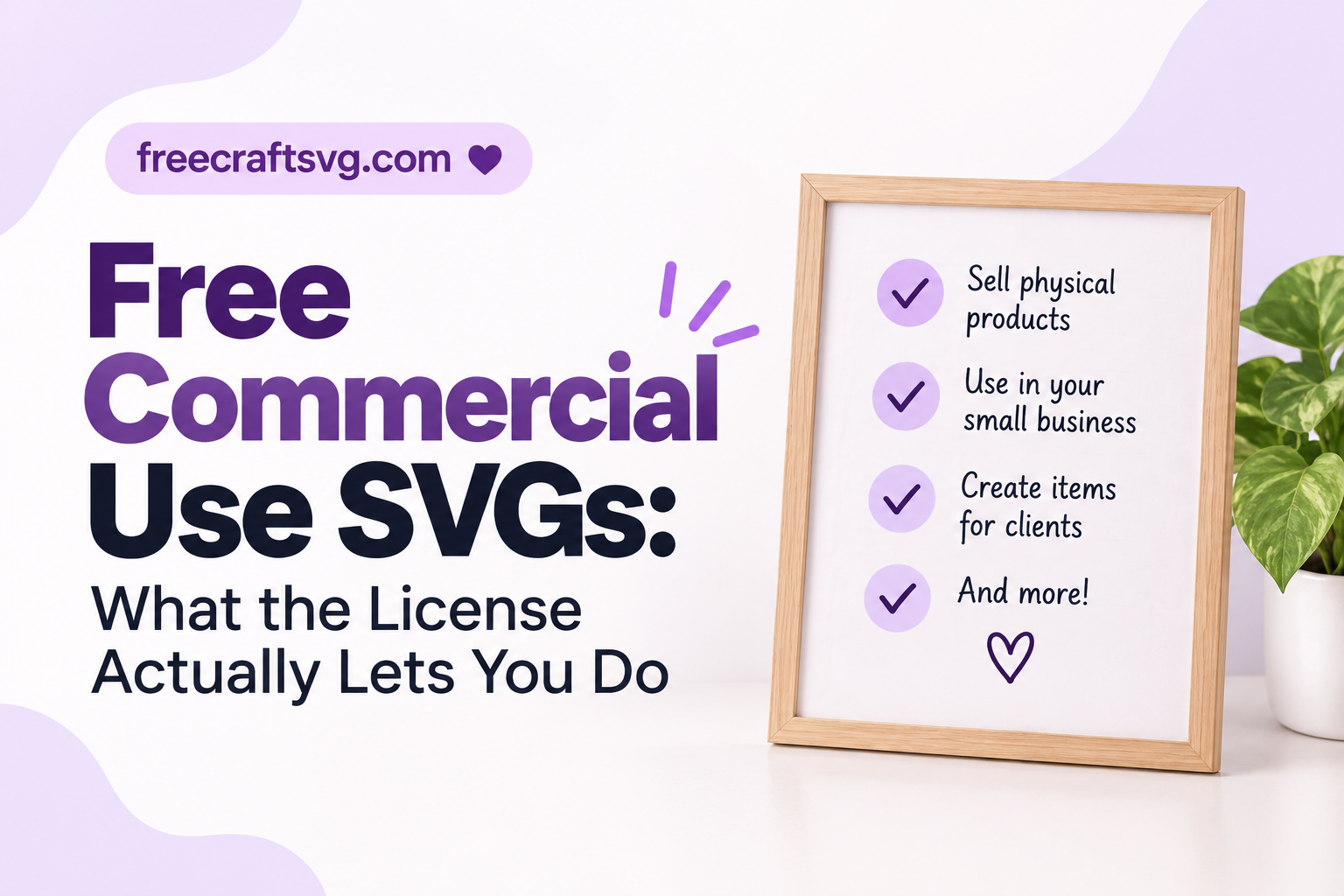
Free Commercial Use SVGs: What the License Actually Lets You Do
A “free commercial use” SVG usually means you may sell the physical things you make with the file — the mug, the shirt, the sign — but you may never sell, share, or give away the file itself. That one sentence covers most of what crafters need to know, though the details vary from site to site, and the details are where people get into trouble.
Quick note before we go further: this is general information about how these licenses are commonly written, not legal advice. Every file you download comes with its own terms, and those terms are the ones that govern your situation.
What does “free commercial use” actually mean?
It helps to separate two different things: the file and the finished item.
The license covers the file. The designer made it, the designer still owns it, and they are giving you permission to use it in certain ways. What you do with your vinyl, your blank, and your afternoon is the finished item.
So “free commercial use” is really shorthand for: you may use this file to make products you sell, and you still may not do anything with the file itself.
This is why “free to download” and “free to sell with” are not the same thing. Plenty of gorgeous files are free to download and clearly marked personal use only. The download costs nothing. The permission to sell is separate — and sometimes it isn’t included.
What does “personal use only” mean in practice?
Personal use almost always means: make it for yourself, your family, and your friends, and don’t take money for it.
In practice that typically covers a shirt for your grandson, a sign for your own kitchen, a gift for a coworker’s retirement, or a set of tumblers for your daughter’s bridal party. Most personal use terms also say you can’t share the file with your craft group, upload it anywhere, or post it in a Facebook group — even if nobody is paying you.
Where people get surprised is the gray area. Selling three shirts at cost to friends is still selling. A church fundraiser is still, usually, a sale. Many personal use licenses draw the line at money changing hands at all, not at whether you made a profit.
If you’re unsure, that’s genuinely the moment to go back and reread the license on that specific file rather than guess.
What does a commercial license usually add — and what stays off-limits?
A commercial license typically adds one thing: permission to sell finished physical products you made with the design.
What it usually does not do is hand over the design. Almost every commercial license we looked at keeps the same core restrictions in place:
- You can’t resell or redistribute the file. Not as a digital download, not in your Etsy shop, not emailed to a friend.
- You can’t put it in a bundle. Collecting files into a set and selling or sharing that set is specifically called out in a lot of terms.
- You can’t claim it as your own or offer it for download. Even for free.
- You usually can’t turn it into a logo or trademark. Clauses saying the design may not be registered as a trademark or used as your primary brand logo are very common.
Then there are the terms that genuinely differ between sites, and these are the ones worth reading every time:
Sales caps. Some licenses allow unlimited sales. Others cap you at a set number of items per design — a few hundred is a common tier — and ask you to buy an extended license above that. If you’re a small seller, you may never hit it. It’s still worth knowing whether a number exists.
Print-on-demand. This one splits several ways, and it’s the most common thing people get wrong. Some licenses flatly prohibit print-on-demand. Some allow it only under your own brand and storefront while prohibiting marketplace platforms like Redbubble or Zazzle. Some allow it with an extended license. Some allow it outright. There is no industry standard here, so never assume.
Digital products. Many commercial licenses are written for physical items only. Turning a cut file into a printable, a digital download, or web graphics is often excluded.
Attribution. Requiring credit is less common than crafters expect. Plenty of sites say credit is appreciated but not required. A few do require it. It’s a quick thing to check.
Personal use vs. commercial use: what’s typically allowed
| Personal use | Commercial use | |
|---|---|---|
| Make it for yourself or as a gift | Typically allowed | Typically allowed |
| Sell the finished physical item | Typically not allowed | Typically allowed |
| Sell at a craft fair or on Etsy | Typically not allowed | Typically allowed |
| Sales quantity limits | N/A | Sometimes capped per design |
| Print-on-demand platforms | Typically not allowed | Varies widely — check |
| Sell or share the file itself | Never | Never |
| Include the file in a bundle | Never | Never |
| Use the design as your shop logo | Typically not allowed | Typically not allowed |
| Sell it as a digital download or printable | Never | Often excluded |
| Use it on licensed characters or brands | No license can grant this | No license can grant this |
Our own terms are laid out in plain language on our commercial use page, and the common questions we get are answered on the FAQ page.
Does one site’s license cover files from another site?
No — and this is the quiet trap.
Here’s how it happens. You find a site with a generous, clearly written commercial use license. You read it once, you feel good about it, and from then on you think of yourself as someone with a commercial license. Six months later your files folder has designs from eight different sites, a Facebook group, two Pinterest downloads, and a bundle someone sent you. And the license you remember reading covers exactly one of them.
Each file carries the terms of the site it came from. A generous license on one site tells you nothing about a file from anywhere else. Free bundles that circulate in craft groups are especially risky, because by the time a file reaches you, nobody in the chain knows who made it or what the original terms said.
What about Disney, sports teams, and other licensed characters?
This is the one to take most seriously.
No SVG site — not ours, not any of them — can give you permission to sell designs featuring characters, logos, or brands owned by someone else. Disney characters, NFL and college team marks, cartoon characters, band logos, and popular movie quotes are owned by the companies that created them. An SVG designer doesn’t own those rights, so they cannot pass them along, no matter how their license is worded.
This is far and away the most common reason handmade sellers lose a shop. Platforms respond to rights-holder complaints, and enforcement often arrives with no warning — sometimes years after a listing goes up. Big brands run active enforcement programs, and “it was a free file” and “everyone else is selling them” are not defenses.
If a design features something you recognize from a movie, a team, or a store shelf, treat it as off-limits for selling regardless of what the download page says.
Before you sell, check these four things
- Where did this file come from? Name the site. If you can’t, don’t sell with it.
- What does that site’s license actually say — for this file? Some sites license free and paid files differently.
- Is there a cap, a print-on-demand rule, or a physical-items-only clause? These are the three that quietly catch people.
- Does the design include a character, logo, team, or brand you recognize? If yes, no license fixes that.
How do I keep track of all this?
Keep a simple record. Truly simple — a spreadsheet or a notes file with four columns: the file name, the site it came from, the date, and whether it was personal or commercial use.
Two minutes when you download saves you an afternoon of panic later. Licenses get updated, sites disappear, and “I’m pretty sure it was fine” is a miserable thing to rely on if anyone ever asks.
Better still, keep a folder structure that mirrors it, so personal-use files physically live somewhere separate from the ones you sell with. The mistake almost nobody makes on purpose is the one worth designing around: grabbing the wrong file from a folder of hundreds at eleven at night before a craft fair.
You don’t need to be nervous about this. Most crafters who get it wrong got it wrong by accident, and a little bit of record-keeping prevents nearly all of it.